
All About | A German Permanent Residency Permit (Niederlassungserlaubnis)| Full Guide, How to Apply, Requirements, And Costs
Obtaining A German Permanent Residency Permit (Niederlassungserlaubnis) is one of the most important milestones a foreign-trained professional can get in Germany. It gives you an open-ended right to live and work in Germany without the need to renew a temporary residence visa. In this guide, we define and examine the Requirements, Process, timelines, and Costs to obtain a German Permanent Residency Permit (Niederlassungserlaubnis).
Apply for and get your Niederlassungserlaubnis (German Permanent Residency Permit) without delay or disappointment.
If you are planning a career in Germany, understanding the settlement permit early can help you choose the right visa, preserve qualifying months, and avoid mistakes that delay your application. It also helps you decide when to move from a temporary work title to a permanent status that supports long-term settlement and family planning.
What Is Niederlassungserlaubnis | German Permanent Residency Permit?

The Niederlassungserlaubnis is Germany’s permanent settlement permit for non-EU nationals. Unlike a temporary residence permit, Niederlassungserlaubnis allows you to remain in Germany indefinitely so long as you meet the “Niederlassungserlaubnis Residency Conditions”
- available after five years of lawful residence, except EU Blue Card holders and certain highly qualified category applicants who qualify sooner.
- For many foreign-trained skilled workers, this permit is the point at which Germany becomes a long-term home rather than a temporary work destination.]
Apply and get your Niederlassungserlaubnis | German Permanent Residency Permit without delay or disappointment.
How to Use this Guide
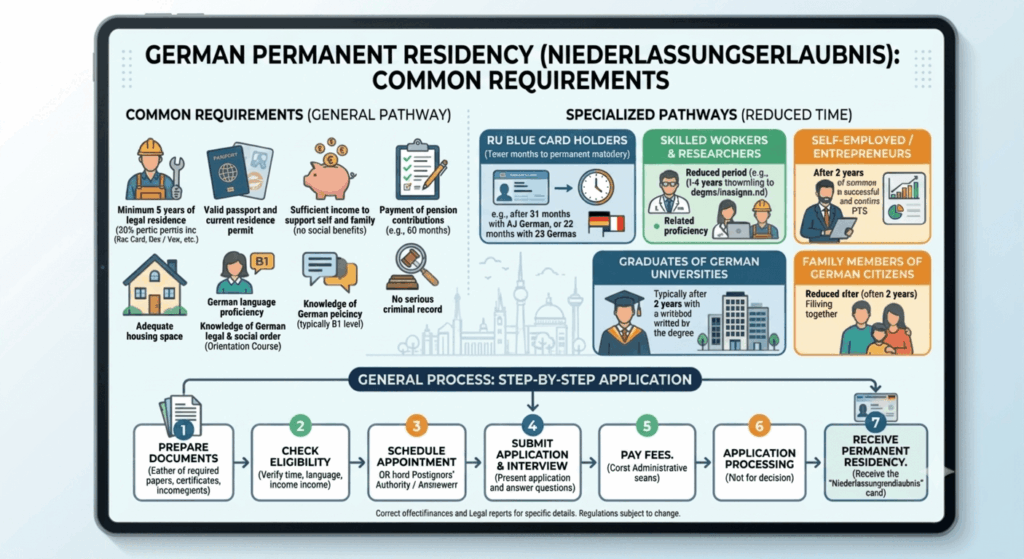
Fastest way to use this guide: review the requirements, compare the qualifying routes, then prepare your documents before your current permit becomes a bottleneck.[2][5]
Apply and get your Niederlassungserlaubnis | German Permanent Residency Permit without delay or disappointment.
Who Qualifies for the Niederlassungserlaubnis | German Permanent Residency Permit?
Germany offers a general route and several accelerated routes for permanent residence.The right route depends on your residence title, work history, pension payments, and integration profile.
- Standard route: Usually after 5 years of legal residence with a qualifying residence permit.
- EU Blue Card route: Faster timeline, often 27 months or 21 months depending on German language level.
- Highly qualified workers: Some applicants under sections 18a, 18b, 18d, or 18g may qualify after 3 years.
- Self-employed applicants: A separate route exists under section 21, with different timing and fees.
- Family-based route: Some spouses of German citizens may qualify earlier under specific conditions.
General Eligibility Rules in 2026
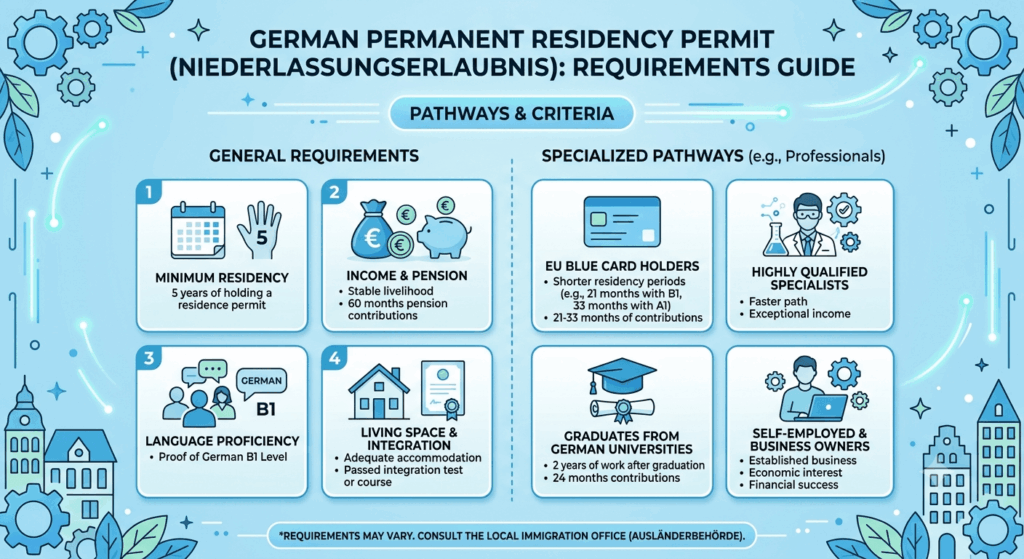
The general requirements for the Niederlassungserlaubnis are still built around long-term integration and financial independence. In practice, authorities want to see that you can live in Germany permanently without relying on public assistance.
- Legal residence: Usually at least 5 years with a valid residence title.
- Pension contributions: At least 60 months of statutory pension contributions for the standard route.
- Stable livelihood: You must be able to support yourself and any dependents without social assistance.
- German language: Usually at least B1 level.
- Knowledge of German society and law: Commonly shown through the “Living in Germany” test or an integration course.
- Adequate housing: Sufficient living space for you and your family.
- No serious criminal concerns: No major public security or order issues.
- Authorized employment: You must be allowed to perform the work tied to your residence status.
These requirements generally check that you are legal and already integrated into Germany’s work and social systems.
Accelerated Route: EU Blue Card Holders
EU Blue Card holders have one of the most attractive fast-track routes to the settlement permit. Berlin’s official service information states that Blue Card holders may qualify after 27 months of employment with basic German knowledge, or after 21 months with sufficient German language skills.
- 27 months: Employment plus basic German language knowledge.
- 21 months: Employment plus sufficient German language skills.
- Residence title requirement: The Blue Card route depends on holding the relevant residence title and meeting the employment and language conditions.
This route is especially relevant for foreign-trained professionals in tech, engineering, healthcare, and other shortage fields who entered Germany through the skilled worker system.
Standard Route After Five Years
The standard settlement permit route remains the most common pathway. It generally requires five years of lawful residence, 60 months of pension contributions, secure livelihood, B1 German, and basic knowledge of German legal and social life.
Student or vocational training time may count only partially in some interpretations, so applicants should verify how earlier residence periods are credited before relying on them.
- Residence period: 5 years of legal stay.
- Contributions: 60 months of statutory pension payments.
- Language: B1 German.
- Integration: Knowledge of German society and law.
- Housing and income: Adequate housing and stable financial support.
If your current permit is tied to one employer or one labor market condition, use the years before eligibility to strengthen your wage history, tax record, and pension file
Highly Qualified Workers and Other Faster Paths
Official settlement permit guidance indicates that some highly qualified workers under sections 18a, 18b, 18d, or 18g can qualify after 3 years rather than five.
- Eligible titles: Sections 18a, 18b, 18d, or 18g of the Residence Act.
- Residence period: 3 years.
- Pension contributions: 36 months.
- Language: B1 German.
- Livelihood: Self-sufficient without state assistance.
This faster timeline is highly relevant for skilled workers who want permanent stability quickly, especially if they entered Germany through a recognized professional route and are already paying into the pension system.
Documents You Need for the Application
Here is a checklist for your Niederlassungserlaubnis | German Permanent Residency Permit Application
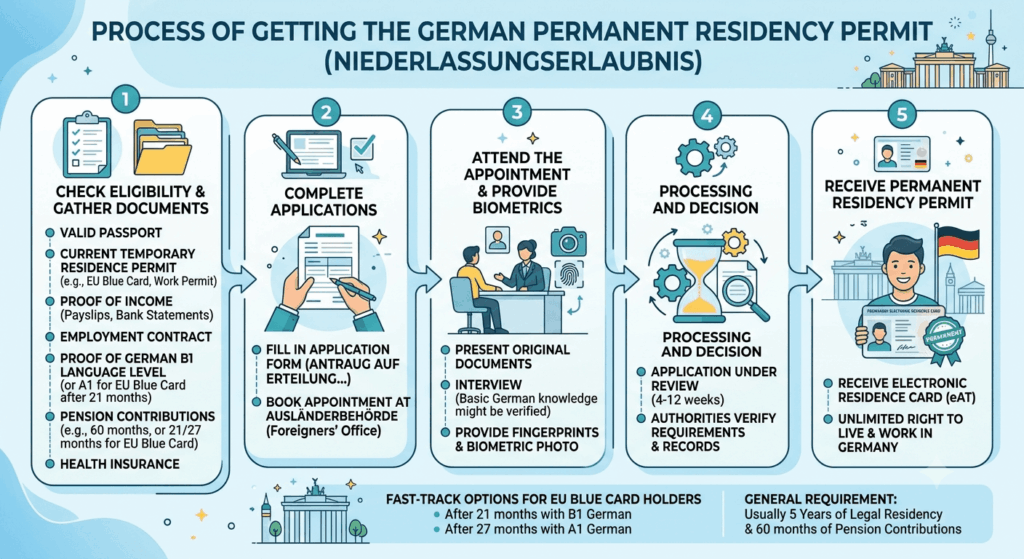
Local immigration offices generally ask for a standard set of identity, residence, income, housing, language, and integration documents. The exact checklist can vary by city, but the core package is consistent across Germany.
- Valid passport and current residence card.
- Completed application form for the Niederlassungserlaubnis.
- Biometric passport photo.
- Meldebescheinigung or proof of registered address.
- Employment contract and recent payslips, or self-employment income records.
- Pension contribution statement showing the required months.
- Health insurance confirmation.
- Rental contract or other proof of adequate housing.
- German language certificate such as B1 or equivalent.
- Integration evidence, such as the Living in Germany test or integration course certificate.
- Tax documents or other financial records where relevant.
- Family documents if applying with a spouse or children.
Many applicants lose time because one document is missing or outdated, especially pension statements, income proof, or housing confirmation.
How Much Does the Permit Cost?
Cost of Niederlassungserlaubnis | German Permanent Residency Permit
The cost depends on the route you use, but the fee is generally in the low hundreds of euros.[1][3][5] Official and semi-official sources show that the settlement permit fee is usually around €113 to €147, with special categories paying different amounts.
- General settlement permit: about €113.
- Highly qualified persons: about €147.
- Self-employed persons: about €124.
- Minors: about €55.
Some sources describe the fee as varying by status group and say payment is due at the time of application.[5][9] Municipal offices may also publish local administrative service details, but the overall fee structure remains broadly consistent.
Processing Time and What Happens at the Appointment
What is the Processing time for a Niederlassungserlaubnis | German Permanent Residency Permit?
Applicants usually begin by booking an appointment with the local foreigners’ office or immigration authority. At the appointment, documents are reviewed, questions may be asked, and the fee is paid.
- Step 1: Book the appointment.
- Step 2: Bring the completed application and all supporting documents.
- Step 3: Pay the application fee at submission.
- Step 4: Wait for processing and possible follow-up requests[3][9]
Processing may take around 2 to 3 weeks after the interview, but this timeline will vary depending on city and workload. In larger cities, appointment wait times themselves can be much longer than the processing period.
What the 2026 Rules Mean for Candidates
For 2026 candidates, the biggest practical message is that planning early matters more than ever IIf you wait until the end of your current permit to organize pension records, language proof, and financial evidence, you may face avoidable delays.
- Blue Card holders should check whether they can apply at 21 or 27 months and prepare the language evidence accordingly
- Standard applicants should track the full 60 months of pension contributions from the start.
- Skilled workers in fast-track categories should confirm which residence title they hold so they do not miss the 3-year route.
- Families should ensure housing, income, and dependent documentation are already organized.
Common Mistakes to Avoid as you apply for your Niederlassungserlaubnis | German Permanent Residency Permit.
If you are early in your German journey, it is worth treating the settlement permit as a long-term project, not a last-minute application.
For many foreign-trained workers, the most expensive mistake is not the government fee; it is losing months because the residence title, job category, or contribution history was not documented correctly.
Most refusals or delays come from missing eligibility evidence rather than from the concept of the permit itself.
- Not enough pension months recorded with the German pension system.
- Using the wrong residence title for the accelerated route.
- Weak or outdated income proof.
- Language documents that do not clearly show B1-equivalent proficiency.
- Incomplete housing evidence.
- Waiting too long to book an appointment in a busy city.
Preparing for your Niederlassungserlaubnis | German Permanent Residency Permite
How Foreign-Trained Skilled Workers Should Prepare Now
Image of a how Niederlassungserlaubnis | German Permanent Residency Permit can be a success path for a foreign trained worker from Africa
The best approach is to work backward from the route you want. If you want the fastest possible settlement permit, you should align your visa category, employment structure, salary proof, and German language progress from day one.
- Track pension contributions from your first month of qualifying work.
- Keep pay slips, tax records, and contract updates in one file.
- Book a B1 exam early if you are aiming for the standard route.
- Confirm your residence title if you believe you qualify for the Blue Card or highly qualified fast-track.
- Maintain stable housing and insurance so your application is not delayed.
If you are also navigating arrival tasks such as registration, insurance, and housing, these internal resources can help: Get started with LearnAbroad.ca, how to complete your German registration, choosing health insurance in Germany, finding housing in Germany, and choosing the right German work visa.
What Action to Take Now
If permanent residence is your goal, the right move is to start preparing before you are technically eligible.[2][4][5] That gives you time to build the required months of pension contributions, improve your German, gather clean documentation, and avoid appointment pressure later.[2][3][9][11]
Take action now because:
Apply and get your Niederlassungserlaubnis | German Permanent Residency Permit without delay or disappointment.
- appointments can be scarce in major cities.
- small document gaps can delay approval.[2][9]
- the fastest routes depend on timing your title and language progress correctly.
- the sooner you prepare, the sooner you can move from temporary status to permanent stability.[3][5][17]
Get Started on your Niederlassungserlaubnis | German Permanent Residency Permit
Learnabroad can help your Get your Niederlassungserlaubnis | German Permanent Residency Permit without delay or disappointments.






 Liberty LearnAbroad Immigration Services