
Move And Work In Canada’s Hospitality Industry In Under 6 Months | Step-By-Step Guide

Want to Move and Work in Canada Hospitality Industry?
We share a five-step process, key benefits, challenges, essential requirements and Frequently Asked Questions (FAQ) to enable you make the dream a reality in under six months.
Let’s make your dream a reality.
The Essence of Canadian Hospitality
Work In Canada Hospitality Industry recognised world over as friendly and very diverse. Available jobs range from stints in small inns to large hotels and resorts. Workers often share a passion for good customer service, creating a welcoming atmosphere.


Why Work in Canada Hospitality Industry?
1.2M +
Industry Workers
Over 1.2 million people employed with multiple vacancies in hotels, restaurants, and tourism businesses
$62.77
Hourly Wage
Top hotel managers can earn up to CAD 62.77/hour with steady career growth opportunities
6
Months
Most work permits and immigration approvals process within 6 months with proper guidance
Why Work in Canada Hospitality industry?
- Good Salaries: Competitive pay depending on the job and location please see below.
- Variety of Jobs: Opportunities in hotels, restaurants, resorts, and events.
- Job Stability: The tourism industry keeps demand steady.
- Career Growth: Training and advancement opportunities are common.
- Travel Opportunities: Work lets you explore Canada’s cities and nature.
- Friendly Work Environment: Canadian hospitality is known for warmth and politeness.

Top-Paying Hospitality Positions
Annual Salaries Paid for Popular Canada Hospitality Jobs
$86k
Hotel Manager
Oversee all hotel operations and staff
$79k
Spa Manager
Direct wellness services and staff
$64k
Store Keeper
Manage inventory and supplies
$57k
Restaurant Manager
Supervise food service operations
Here are some common jobs with average salaries:
- Storekeeper: About CAD 64,460 per year
- Front Desk Clerk: About CAD 42,876 per year
- Bartender: About CAD 41,952 per year
- Restaurant Manager: About CAD 57,039 per year
- Spa and Wellness Manager: About CAD 78,671 per year
- Food Service Worker: About CAD 39,861 per year
- Housekeeper: About CAD 47,209 per year
- Cashier: About CAD 37,394 per year
- Kitchen Helper: About CAD 38,305 per year
- Hotel Manager: About CAD 86,473 per year
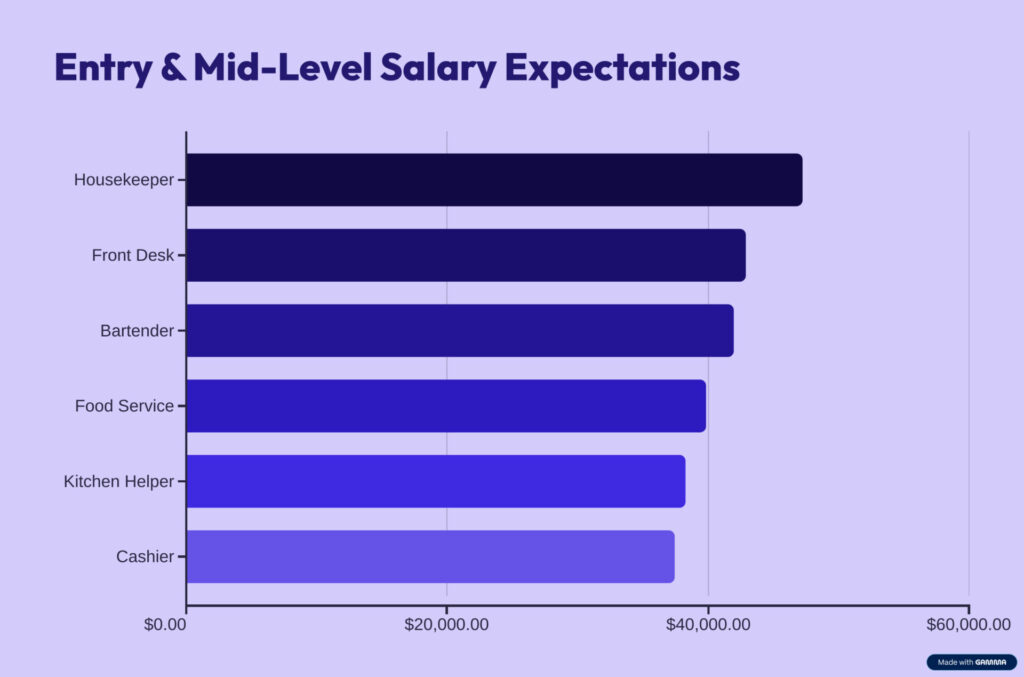
Salaries vary by province and job demand.
How to Work in Canada Hospitality Industry
One of the main requirements to work in Canada’s hospitality sector, is a job offer from a Canadian employer. and a work permit that allows you to legally work in Canada.
Work Permits for Canada Hospitality Industry Workers
There are several types of work permits for foreign workers in Canada’s hospitality sector:
- Temporary Foreign Work Permit (TFWP):
This permit allows employers to hire foreign workers if they cannot find qualified Canadians. Employers must get a Labor Market Impact Assessment (LMIA) to prove this. The TFWP is employer-specific, meaning you can only work for the employer who hired you.
- International Mobility Program (IMP):
This program lets employers hire foreign workers without an LMIA. It includes streams like Post-Graduation Work Permits and Intra-Company Transfers. Depending on the stream, you may get an open or employer-specific work permit.
- International Experience Canada (IEC) Working Holiday Program:
For people aged 18-35 from certain countries, this program allows you to work and travel in Canada for up to two years. It gives you an open work permit to work for any employer in hospitality.
Qualifications Needed to Work In Canada Hospitality Industry
The qualifications depend on the job level:
- Management Jobs:
Usually require a degree in business or hotel management.
- Mid to Senior-Level Jobs:
Cooks and chefs need vocational training or apprenticeships.
- Entry-Level Jobs:
Such as front desk clerks or housekeepers, usually require a high school diploma and specific job training.
Tips to Succeed
To do well in Canada’s hospitality sector, focus on:
- Strong communication skills in English or French
- Excellent customer service
- Being adaptable and flexible
- Building a professional network
Why Choose to work in Hospitality in Canada?
| Feature | Benefit |
|---|---|
| Strong Job Demand | Over 1.2 million people are employed in this sector and we multiple vacancies in hotels, restaurants, and tourism businesses |
| Variety of Roles | From front desk to chef, housekeeper to sales manager – wide range of entry-level and skilled positions |
| Competitive Salaries | Hotel managers earn up to CAD 62.77/hour; steady career growth opportunities |
| Supportive Immigration Programs | Work permits, provincial nominee programs, and Alberta Tourism & Hospitality Stream tailored for hospitality workers |
| Realistic Processing Times | Most work permits and immigration approvals process within 6 months with proper guidance |
The Challenges Faced Globally
- Complex visa and work permit processes that can delay job start times.
- Meeting Canadian language proficiency and credential recognition standards.
- Securing a valid job offer from an approved employer in a competitive hospitality sector.
- Adjusting to new cultural and work environments abroad.
- Navigating costs related to immigration applications and relocation.
Our comprehensive program and expert support at LearnAbroad tackle these hurdles to smooth your path to success.
5 Amazing Benefits of the Move Abroad with Learnabroad Program
- Fast-track Relocation: Move and start working in Canada’s hospitality sector in under six months.
- Job Placement Assistance: Access to employers actively hiring in hotels, restaurants, and tourism.
- Visa Application Support: Expert guidance to prepare and submit all immigration documents correctly.
- Credential and Language Help: Assistance with educational credential assessments and language test prep.
- Settlement Services: Ongoing support to help you adapt to Canadian life and work culture.
Basic Requirements for the Program
To qualify for working in Canada’s hospitality sector, you typically need to meet the following:
- Valid passport and clean criminal record.
- Job offer from an approved Canadian employer in hospitality (hotel, restaurant, tourism).
- Minimum 6 months (780 hours) of full-time paid work experience, preferably in hospitality roles.
- Language proficiency at CLB Level 4 or above in English or French (IELTS, CELPIP, or TEF results).
- Educational credentials equivalent to Canadian high school or higher (ECA report).
- Proof of financial ability to support yourself and your dependents during the application process.
- Medical examination clearance if required.
Target Groups and Occupations Likely to Benefit
- Personal support workers and caregivers.
- Housekeeping staff and hotel cleaners.
- Front office staff, booking agents, receptionists.
- Commis chefs and kitchen staff.
- Sales and marketing managers in hospitality.
The simple 5 Step Process
Typical timeframe: 4-6 months from job offer to arrival in Canada.
Step-By-Step Process to Move and Work in Canadian Hospitality
- Assess Eligibility: Use LearnAbroad’s eligibility assessment to identify the best immigration pathway and confirm your credentials.
- Secure a Job Offer: Search for hospitality jobs in Canada through employer networks and job portals. LearnAbroad provides job search assistance focused on in-demand roles.
- Prepare Documentation: Gather passports, job offer letters, language test results, and educational credential assessments.
- Apply for Work Permit: Submit your work permit application online with LearnAbroad’s support, ensuring all fees and biometrics are handled promptly.
- Relocate and Start Work: Once approved, plan your move. LearnAbroad offers settlement services to help you integrate and start your career successfully.
How LearnAbroad Can Help You
LearnAbroad is your trusted partner for a smooth Canadian hospitality career transition. Our services include:
- Personalized eligibility assessments to match you with the best programs.
- Step-by-step visa and permit application management.
- Tailored job search and employer introduction in the hospitality sector.
- Credential evaluation guidance and language preparation.
- Comprehensive settlement support, from arrival to employment.
Get help from experienced consultants dedicated to turning your Canadian work dream into reality.
Testimonials
“Thanks to LearnAbroad, I moved from Kenya to Toronto in five months and landed a job as a front desk agent. Their step-by-step support made all the difference.” – Mary A.
“LearnAbroad’s guidance in language testing and job search helped me secure a chef position in Vancouver much faster than I expected.” – Samuel O.
Success Stories
- Success Story 1: Angela, a 30-year-old hospitality manager from Nigeria, used LearnAbroad’s program to obtain a work permit and start managing a boutique hotel in Calgary within 5 months.
- Success Story 2: David, 27, from Ghana, worked as a housekeeper before applying with LearnAbroad’s support, and now enjoys a stable career and permanent residency pathway in Alberta’s hospitality industry.
Call-to-Action (CTA)
Ready to move to Canada and work in hospitality? Let LearnAbroad make the process simple and efficient. Book an Appointment today or Contact Us for a free consultation. Discover how easy your Canadian hospitality career journey can be!
Frequently Asked Questions (FAQ)
1. What types of hospitality jobs are in demand in Canada?
Jobs such as chefs, cooks, food counter attendants, kitchen helpers, hotel cleaners, housekeepers, personal support workers, caregivers, nursing assistants, and hospitality supervisors are in high demand across Canada.
2. How long and what is the cost does it take to get a Canadian work permit for hospitality?
The process typically takes about 6 months from job offer to starting work. Costs include government fees (work permit: approx. CAD 155), biometrics (CAD 85), and possibly credential assessments or medical exams. Additional costs may apply for document translation or legal assistance.
3. Do I need a job offer to apply for a work permit?
Yes, for most hospitality work permits, you need a valid job offer from a Canadian employer. Some streams require a Labour Market Impact Assessment (LMIA) as well.
4. What language level is required for hospitality work visas?
You generally need English or French skills at Canadian Language Benchmark (CLB) level 4–5 for most hospitality roles.
5. Can I bring my family with me?
Yes, you can include your spouse and children in your application. They may be eligible for open work permits or study permits, depending on your situation.
6. How much does the visa application cost?
The main government fee for a work permit is about CAD 155. Biometrics cost CAD 85. There may be additional costs for medical exams, credential assessments, and translations.
7. Are there age limits for applying?
There are no strict age limits for most work permits, but some programs (like the International Experience Canada) have age restrictions. Most hospitality immigration pathways are open to adults of working age.
8. What documents do I need for credential assessment?
Typically, you need your educational certificates, transcripts, proof of work experience, and sometimes a credential evaluation from a recognized Canadian service.
9. Can I apply without prior work experience?
Most programs require at least 1–2 years of relevant hospitality work experience. Entry-level positions may have more flexibility, but experience greatly improves your chances.
10. What provinces have the most hospitality jobs?
Ontario, British Columbia, Alberta, and Quebec have the highest demand for hospitality workers, especially in major cities and tourist regions.
11. How does LearnAbroad assist with job placement?
LearnAbroad connects you with verified Canadian employers, helps you prepare your resume, supports you through the interview process, and guides you through the visa application and settlement process.
12. Is medical exam mandatory?
Yes, a medical exam is usually required for work permits in hospitality, especially if you will be working in healthcare or with vulnerable populations.
13. Can I switch jobs after arriving in Canada?
If you hold an employer-specific work permit, you need to apply for a new permit to change employers. Open work permits allow more flexibility, but are less common in hospitality streams.
14. What is the Alberta Tourism and Hospitality Stream?
This is a provincial immigration program that allows Alberta employers to hire foreign workers for tourism and hospitality jobs. It can provide a pathway to permanent residency for eligible candidates.
15. Are there training or language courses offered?
Yes, many employers and settlement agencies offer language and job training programs to help you adapt and succeed in Canada’s hospitality sector
Relevant Internal Links to Learn More
- Get Started – Begin your Canadian work journey.
- Appointment Booking – Schedule your free eligibility assessment.
- Contact Form – Reach out with your questions.
- Register as a Medical Professional – For healthcare workers considering Canada.
- Study Overseas on a Student Work Visa – Explore education-to-work pathways.
This guide is designed to give you a clear, actionable plan to make your Canadian hospitality career dreams come true, with realistic timelines, transparent costs, and expert support every step of the way.




 Liberty LearnAbroad Immigration Services