

Canada Expands Manitoba Francophone Immigration: New Opportunities for Workers and Students
Manitoba Francophone Immigration: New $1.3M Investment and Student Pilot Extension Unlocks Opportunities for Workers and Students
Introduction: Why Manitoba is Becoming a Top Destination for Francophone Talent
For French-speaking international students and skilled workers, navigating Canada’s immigration system can feel overwhelming—especially when balancing language requirements, labor market alignment, and permanent residence pathways. Many qualify on paper but get stuck in bureaucratic limbo or face high study permit refusal rates from their home regions.
That’s why the July 6, 2026 joint announcement by the Government of Canada and the Government of Manitoba is a game-changer. With a CAD 1.3 million investment in a new Manitoba Francophone immigration project and the extension of a critical student pilot, the province is proactively removing barriers for Francophone and bilingual candidates.

This initiative doesn’t just promise opportunities—it actively streamlines credential recognition, promotes Manitoba’s Francophone communities through digital tools, and aligns candidates with real labor needs. Whether you’re a nurse, engineer, or student, this could be your pathway to a new life in Canada.
Key Details of the July 6, 2026 Announcement
On Monday, July 6, 2026, Minister of Immigration, Refugees and Citizenship Lena Metlege Diab announced in Winnipeg an investment of approximately $1.3 million to launch a new Francophone Immigration Support Program project specifically for Manitoba.
The project focuses on four strategic pillars:
- Targeted promotion and digital solutions to attract Francophone newcomers to Manitoba
- Targeted research to understand barriers and opportunities for Francophone immigration
- Enhanced foreign-credential and skills-recognition support, especially for healthcare workers
- Alignment of Francophone and bilingual candidates with Manitoba’s specific labor market needs
Funding will be distributed over two years through the Francophone Immigration Support Program (FISP). This effort complements the broader federal $25 million investment over five years in the Centre for Innovation in Francophone Immigration as part of the Action Plan for Official Languages 2023–2028.

Francophone Minority Communities Student Pilot Extended to August 2027
A major component of the announcement is the **one-year extension** of the **Francophone Minority Communities Student Pilot (FMCSP)** through **August 2027**[1][3].
This pilot program is designed for **French-speaking international students** from regions with **historically high study permit refusal rates**. It facilitates access to Canada’s International Student Program (ISP) by offering:
- Settlement and integration services during studies
- Pathway to permanent residence after graduating from an eligible program at a participating designated learning institution[1][3]
- Right for immediate family members to accompany the student to Canada[1][3]
To date, **515 Francophone students** and **150 accompanying family members** have arrived in Canada under FMCSP[1]. The first participants could graduate and apply for permanent residence as early as **2027**[1][3].
Eligibility and Program Requirements
While the new initiatives create clearer pathways, **they do not guarantee nomination, admission, a study permit, or permanent residence**. Applicants must still meet all standard program requirements.
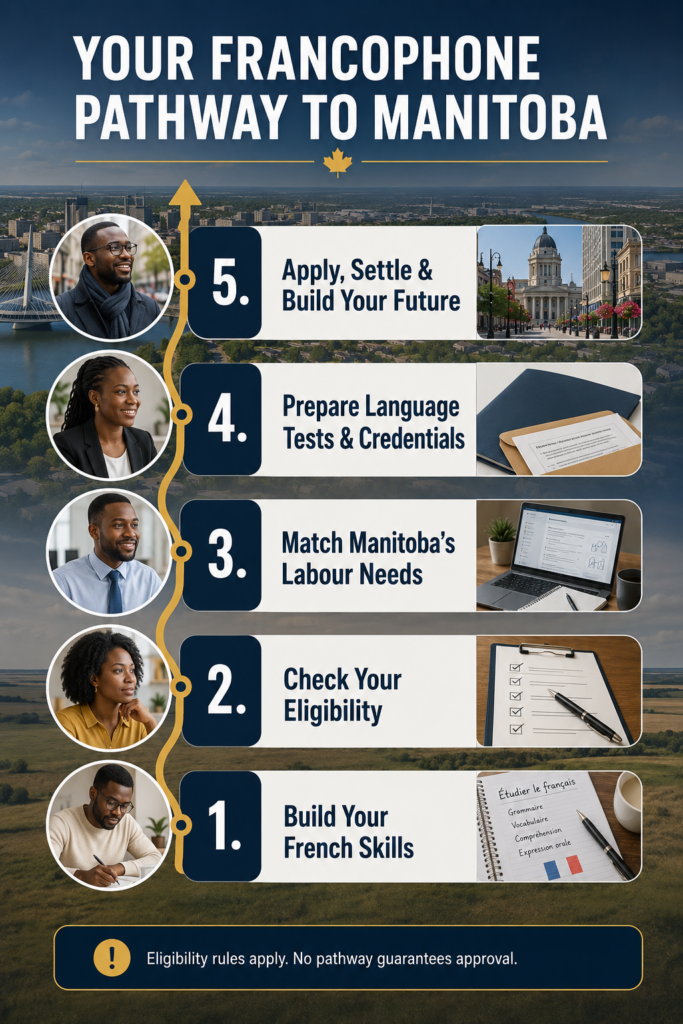
Key requirements include:
- Language proficiency: Valid French-language test results (typically NCLC 7 or higher for Express Entry)[6]
- Education: Completion of required academic credentials with proper verification
- Occupation match: Skills must align with Manitoba’s labor market needs
- Admissibility: No criminal, medical, or security bars to entry
- Program criteria: For FMCSP, enrollment at a participating designated learning institution in a Francophone minority community outside Quebec[1][3]
For skilled workers, the new project will strengthen **credential recognition**, especially in healthcare, making it easier to prove equivalency with Canadian standards[4].
Success Story: From Kenya to Winnipeg – A Francophone Nurse’s Journey
Amara K. arrived in Winnipeg in 2024 as one of the first FMCSP participants from East Africa. Despite holding a nursing degree from Kenya, she faced initial hurdles with credential recognition and language testing.
Through the pilot’s settlement services, she received tailored French-language coaching and mentorship from local Francophone healthcare professionals. Within six months, her credentials were recognized, and she secured a job at a Manitoban hospital.
“The FMCSP didn’t just give me a study permit,” Amara says. “It gave me a community, support, and a real path to stay in Canada.” In 2027, she will apply for permanent residence—fulfilling the pilot’s promise.
Frequently Asked Questions (FAQ)on Manitoba Francophone Immigration Project
- What is the Manitoba Francophone immigration project announced in July 2026?
It is a new $1.3 million project to boost Francophone immigration via promotion, digital tools, research, and credential support. - Does the FMCSP extension guarantee permanent residence?
No. It enables study and settlement services, but PR requires graduation + meeting IRCC criteria. - Can family members accompany FMCSP students?
Yes, immediate family can accompany them. - What French level is required?
Typically NCLC 7 for Express Entry; other programs vary. - Are there program costs?
Yes: tuition, permit fees, and living costs are not covered by the pilot. - How long is the timeline to PR?
Study (1–4 yrs) + PR processing (6–12 mos) = 2–5+ years total. - What documents are needed?
French test, academic proof, acceptance letter, financial proof. - Do students have work rights?
Yes: on-campus (no permit), off-campus (20 hrs/week term, full-time break). - What PR pathways exist after graduation?
Express Entry (French bonus), PNP, CEC. - Is there an age limit?
No official limit, but all standard criteria must be met[1].
Conclusion: Your Francophone Future in Manitoba Starts Now
The July 6, 2026 announcement marks a pivotal moment for Manitoba Francophone immigration**. With **$1.3 million in new funding**, streamlined credential recognition, and the **FMCSP extended to August 2027**, the province is actively building a welcoming pathway for French-speaking students and workers.
But remember: **no guarantee of nomination, admission, or permanent residence** exists. You must still meet all language, education, occupation, and admissibility requirements.
If you’re a French-speaking international student or skilled worker, Manitoba could be your next home. Let **LearnAbroad.ca** guide you through every step—from application to permanent residence.




 Liberty LearnAbroad Immigration Services